Suit of Swords · air
Three of Swords
The Three of Swords names the clean pain of a truth that wounds: heartbreak, loss, or words that cannot be unsaid. Its sorrow is honest rather than cruel; acknowledging the hurt fully, rather than numbing it, is what allows the storm to pass and the heart to mend.
The image
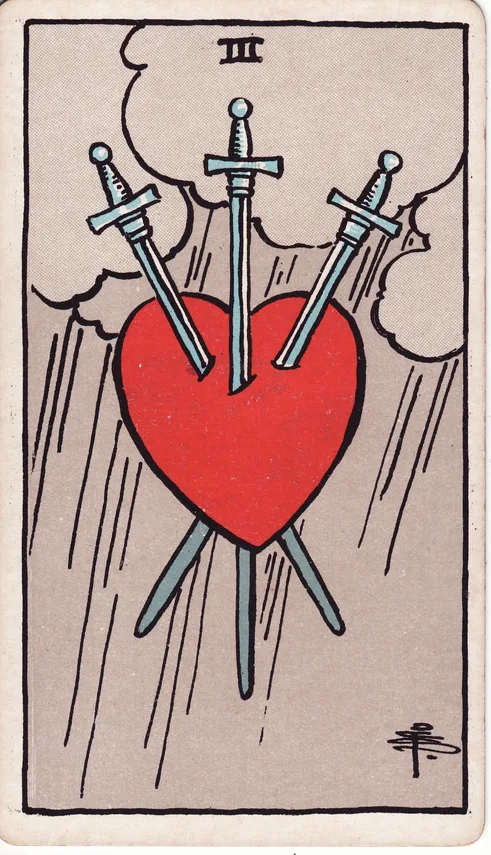
Three swords pierce a single red heart, suspended against a grey sky heavy with rain.
Upright
Reversed
Reversed
Reversed, the Three of Swords begins to draw the blades out: heartbreak easing, grief releasing, the slow work of recovery and forgiveness. Read it as healing underway, or the lingering ache of a hurt not yet fully gone. The card asks what you are ready to release, and what tending the wound still needs.
In a reading
In relationships
In relationships, the Three of Swords is heartbreak: betrayal, separation, the painful truth that cuts. Read it as sorrow that has to be felt rather than rushed. Reversed, it points to recovery or reconciliation, the pain loosening its grip, and asks what forgiveness, of another or of yourself, would free up.
In work & money
In work, the Three of Swords is the painful truth: harsh feedback, a falling-out, a disappointment that stings. Read it as a necessary if unwelcome clarity. Reversed, it favours recovery and moving past the hurt, and asks what lesson the pain leaves once it fades.
Across the decks
Every card has a paper trail. How Three of Swords has been drawn across the cornerstone decks.
Visconti & Marseille
15th-18th c.Three swords interlaced on the old decks; the Visconti Three of Swords is one of the deck's lost cards.
Rider-Waite-Smith
1909Smith pierces a single red heart with three swords against falling rain, plain sorrow.
Thoth
1938-1943Crowley titles it Sorrow; Harris drives three swords through a withered bloom.
Stay in the loop
From the Canon
Updates from Tarot Canon, when there is something worth sharing.