Major Arcana · Water
The High Priestess
The High Priestess guards the threshold of inner knowing that words cannot fully reach. She invites you to be still and trust what you sense beneath the reasoning mind. Reflect on what you already quietly know but have not let yourself acknowledge, and where patience may serve you better than action.
The image
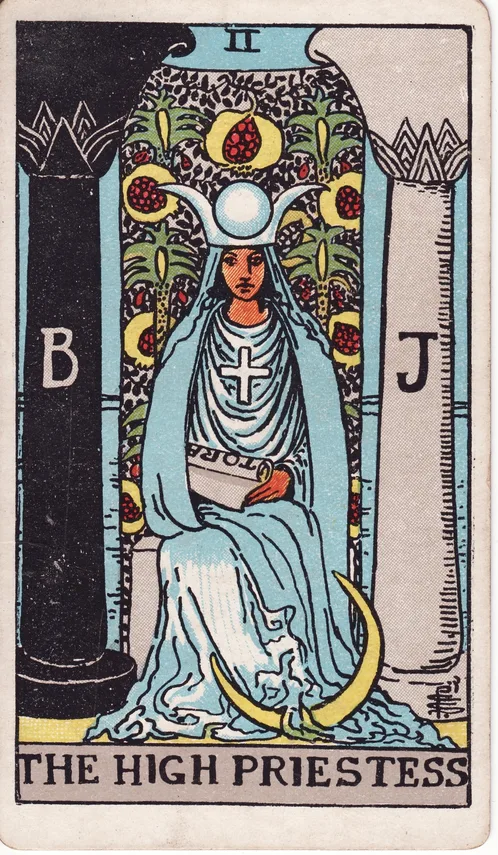
A veiled priestess sits between two pillars marked B and J, a crescent moon at her feet, a Torah scroll partly hidden in her lap, and a solar cross on her chest. A veil of pomegranates hangs behind her.
Upright
Reversed
Reversed
Reversed, the High Priestess marks a break with your own inner knowing: the quiet signal is there but drowned out, or deliberately ignored in favour of what is easier to say out loud. Read it as secrets kept past their usefulness, whether others' or your own, or as a reliance on surface knowledge when something deeper is asking to be felt. The card invites you back to the stillness you have been avoiding.
In a reading
In relationships
In relationships, read the High Priestess as what goes unspoken: the undercurrents, the things sensed but not yet named. Upright she counsels listening beneath the words and trusting your read of a situation. Reversed, she points to withheld feeling or a gut sense you are talking yourself out of, and asks what the silence is protecting.
In work & money
In work, the High Priestess favours the answer you arrive at quietly rather than by committee: the hunch worth honouring before the data confirms it. Read her as permission to wait and watch rather than force a decision. Her shadow is information held back, yours or others', so the reflection is what is not being said in the room.
Across the decks
Every card has a paper trail. How The High Priestess has been drawn across the cornerstone decks.
Visconti-Sforza
c. 1450, MilanThe famous Visconti 'Popess' sits in a nun's habit with a book and a soft triple tiara, traditionally identified with Sister Manfreda, a Visconti kinswoman elected pope by a heretical sect.
Tarot de Marseille
17th-century woodcutLa Papesse keeps the seated, book-bearing form, a veiled female pope that scandalised some later printers into renaming her.
Rider-Waite-Smith
1909Waite recasts her as the veiled priestess between the pillars Boaz and Jachin, a lunar crescent at her feet and the Torah scroll half-hidden in her lap.
Thoth
1938-1943Harris paints the Priestess as a veil of light and crystal, Artemis and Isis, a bow and a camel dissolving behind the falling drapery.
Card pairings
How The High Priestess reads alongside cards it often turns up with.
The High Priestess + The Moon
Both cards belong to the lunar, unconscious side of the deck, but they read differently together. The High Priestess is intuition you can trust, the quiet inner knowing; the Moon is the fog of illusion and projection. Drawn side by side they ask you to sort the genuine signal from the anxious mirage.
The High Priestess + The Magician
The Magician and the High Priestess are the deck's two pillars, the active and the receptive. The Magician acts outward, shaping the world by will; the High Priestess waits inward, knowing by stillness. Together they ask you to pair doing with listening, neither manifesting blindly nor only contemplating.
Stay in the loop
From the Canon
Updates from Tarot Canon, when there is something worth sharing.