Major Arcana · Air
The Fool
The Fool marks the threshold of a journey taken in trust rather than certainty. It invites you to notice where you are being asked to begin again with beginner's eyes, holding plans loosely. Reflect on what becomes possible when you stop needing the whole path mapped before the first step.
The image
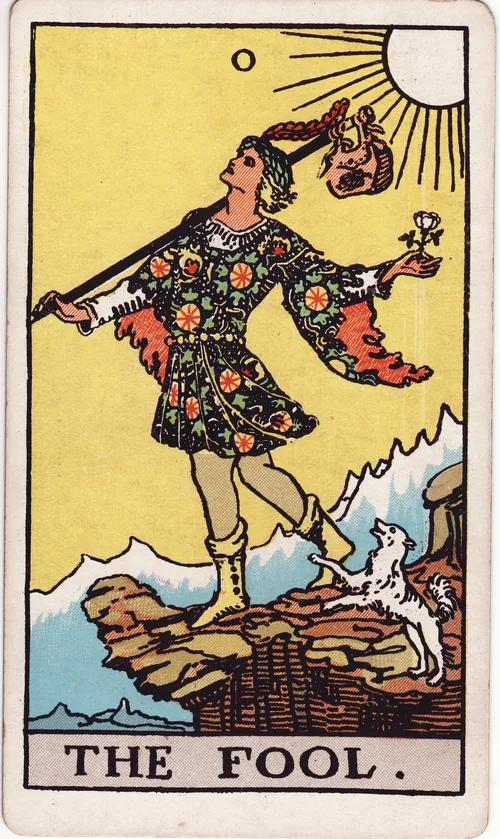
A youth steps toward a cliff edge, face turned to the sky, a white rose in one hand and a small bundle on a staff over the shoulder. A small white dog leaps at the heels. Sun shines behind snow-capped peaks.
Upright
Reversed
Reversed
Reversed, the Fool's openness curdles at one of two edges. Read it as the leap refused: the threshold is in front of you and you are busy negotiating reasons to stay, mistaking caution for wisdom. Or read it the other way, as the leap taken blind, movement without footing, a beginning started so carelessly the bundle gets left behind on the staff. Either way the card asks what a first step would actually cost, and whether the larger risk is the cliff or the standing still.
In a reading
In relationships
In a reading about relationships, the Fool asks for beginner's eyes. Read it as an invitation to meet someone, or to meet a familiar person again, without the case file you have built on them. It favours the unguarded gesture over the strategic one. Its caution is the flip side of its gift: trust offered before it is fully earned, which is either where intimacy begins or where it gets careless.
In work & money
In work and money, read the Fool as the unproven idea that has not yet been argued out of you, the side project or change of direction raised before the spreadsheet can answer it. The reflection it offers is less whether the plan is sound than whether you have stopped beginning things at all, and what it would take to start one in good faith rather than in haste.
Across the decks
Every card has a paper trail. How The Fool has been drawn across the cornerstone decks.
Visconti-Sforza
c. 1450, MilanIn the oldest surviving cards, hand-painted for the Milanese court, the Fool is no carefree youth but a ragged, barefoot figure: feathers in his unkempt hair, a club over one shoulder, in some versions an exaggerated goiter. He is the outcast and the holy fool of the medieval wild-man tradition, set deliberately outside the numbered trumps.
Tarot de Marseille
17th-century woodcutThe Marseille woodcut tradition fixes the card's enduring shape and its French name, Le Mat. A bearded traveller in a belled cap walks on with a bindle slung from a staff while a dog tears at his leg. A performer above the waist and a vagabond below it, he remains the wanderer, and remains unnumbered.
Rider-Waite-Smith
1909Pamela Colman Smith's drawing is the image most people now picture: a young figure stepping toward a cliff edge, face to the sky, a white rose in one hand and a bundle on a staff, a small white dog at the heels beneath snow-capped peaks. The beggar has become the innocent on the brink of the journey.
Thoth
1938-1943Aleister Crowley and Lady Frieda Harris remake the Fool as a composite of myth: the green man of spring, Parsifal the pure fool, the silent child-god Harpocrates. Tiger, crocodile, dove, butterfly and grapes crowd the design, which Crowley read as a glyph of the creative light, the divine madness that comes before form.
Card pairings
How The Fool reads alongside cards it often turns up with.
The Fool + The World
The Fool and the World bookend the major arcana, zero and twenty-one, the first step and the finished journey. Drawn together they frame a whole cycle: read them as a reminder that every completion is also a threshold, and that arriving at the World returns you, wiser, to the Fool's open road.
The Fool + The Magician
Zero and one, the Fool and the Magician are potential meeting the will to use it. The Fool is the leap; the Magician is the hand that shapes what the leap begins. Together they ask whether you have both the raw openness and the focus to make something of it, or only one without the other.
Stay in the loop
From the Canon
Updates from Tarot Canon, when there is something worth sharing.