Suit of Swords · air
Five of Swords
The Five of Swords explores victory that costs more than it gives, the empty triumph of being right at the expense of connection. It asks you to weigh what winning is really worth, and whether the battle in front of you is one worth fighting at all.
The image
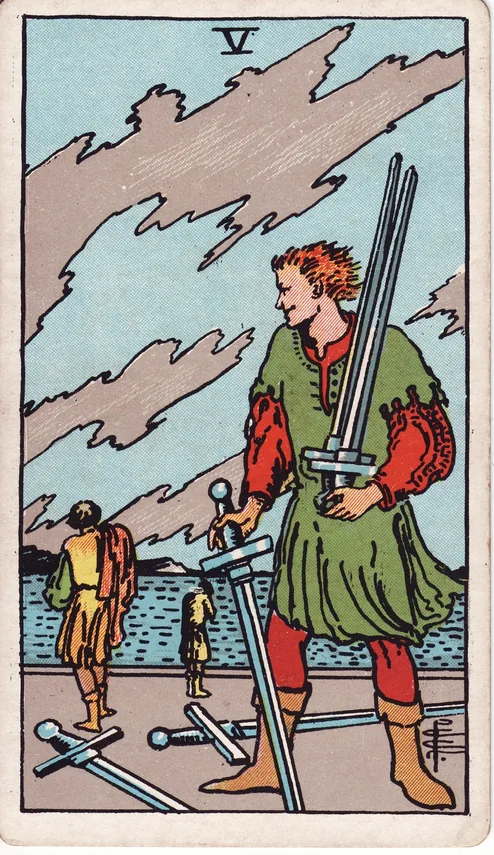
A smirking figure gathers swords from the ground while two defeated figures walk away beneath a jagged, windswept sky.
Upright
Reversed
Reversed
Reversed, the Five of Swords lays down the swords: reconciliation sought, amends made, resentment finally released. Read it as the willingness to repair after a costly fight, or the lingering discord that still needs clearing. The card asks whether the win was worth what it cost, and what it would take to make peace.
In a reading
In relationships
In relationships, the Five of Swords is the fight nobody really wins: scoring points, being right at the cost of the bond, tension that leaves everyone bruised. Read it as a prompt to ask whether winning is worth it here. Reversed, it favours making amends and releasing resentment, and asks what reconciliation would require of your pride.
In work & money
In work, the Five of Swords is the hollow victory: winning by undercutting others, conflict that poisons the air, a cost that outlasts the gain. Read it as a caution about how you compete. Reversed, it points to repairing relationships and moving on, and asks whether old workplace resentment is worth keeping.
Across the decks
Every card has a paper trail. How Five of Swords has been drawn across the cornerstone decks.
Visconti & Marseille
15th-18th c.Five swords set in an interlaced pattern on the old decks.
Rider-Waite-Smith
1909Smith's smirking victor gathers swords as two defeated figures withdraw, a hollow win.
Thoth
1938-1943Crowley titles it Defeat; Harris scatters five mismatched blades in disarray.
Stay in the loop
From the Canon
Updates from Tarot Canon, when there is something worth sharing.