Major Arcana · Water
Death
Death rarely means literal ending; it names transformation and the clearing away of what has run its course. It invites you to release what is finished so something new can take root. Reflect on what is asking to be let go, and how an ending might be the doorway to renewal.
The image
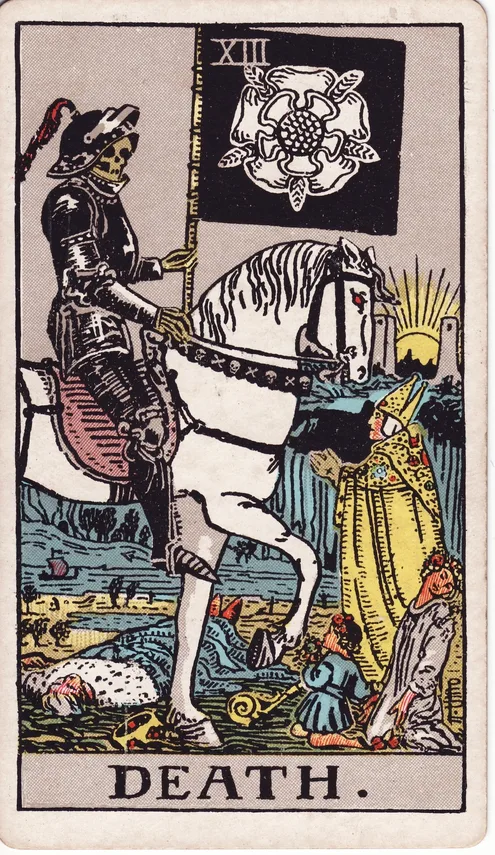
A skeletal figure in black armor rides a white horse, carrying a black banner with a white rose. Figures fall or kneel before it; a bishop, a child, and a maiden. The sun rises between two towers in the distance.
Upright
Reversed
Reversed
Reversed, Death is the ending resisted: the change is due but you are holding the door shut against it. Read it as clinging to what is already over, a transition left half-finished, or the particular exhaustion of refusing a necessary loss. The card asks what you are keeping alive past its time, and what new thing cannot begin until you let the old one close.
In a reading
In relationships
In relationships, Death rarely means an ending to fear; read it as transformation, a relationship shedding an old form so a truer one can take its place. Upright it favours release and renewal. Reversed, it points to clinging, to staying in a dynamic that has already ended in all but name, and asks what you are afraid to let go of.
In work & money
In work, Death is the clean ending that clears the ground: a role, a project, or a way of working that has run its course. Read it as transformation rather than mere loss. Reversed, it names the stagnation of holding on too long, the change you keep deferring, and asks what renewal is waiting on the other side of an overdue close.
Across the decks
Every card has a paper trail. How Death has been drawn across the cornerstone decks.
Visconti-Sforza
c. 1450, MilanA great skeleton stands with a bow drawn, a hunter of high and low alike, painted with a grim courtly elegance.
Tarot de Marseille
17th-century woodcutOften left nameless, the thirteenth card shows a skeleton mowing a field of heads and limbs, the harvest that spares no rank.
Rider-Waite-Smith
1909Waite turns it to allegory: Death as an armoured rider with the white-rose banner, a king fallen and a child kneeling, a sun rising between towers.
Thoth
1938-1943Crowley's Death is a skeleton in a dance, the scythe weaving bubbles of new forms, the fish, scorpion and eagle of Scorpio's threefold nature.
Card pairings
How Death reads alongside cards it often turns up with.
Death + Judgement
Death and Judgement are both cards of endings and what follows, but at different depths. Death is the ending that clears the ground; Judgement is the call to rise from it, transformed. Drawn together they mark a profound passage, an old life closed and a new one answered for.
Death + The Tower
Two cards of endings, but of different kinds. Death is the ending that completes a cycle, often gradual and even natural; the Tower is the sudden, involuntary kind. Drawn together they mark a deep clearing, and ask you to tell apart what is ending in its own time from what is being torn away.
Further reading
Writing by other people, published elsewhere. We are not paid for these.
- Tarot Card Meanings: Death →
by Lucy, Tarot Cake
A long read on the Death card, working through upright and reversed meanings and comparing how the card is drawn across several decks.
Stay in the loop
From the Canon
Updates from Tarot Canon, when there is something worth sharing.